Geopolitics at Its Source: Rudolf Kjellén on Politics as Science
Preamble
This is a translation of Rudolf Kjellén's article titled Politiken som vetenskap - or, as it would be translated in English, Politics as Science. The article was published in Göteborgs Aftonblad on the 22nd and 26th of March, 1901, and was later included as an appendix to Kjellén's 1916 magnum opus, Staten som livsform - The State as Lifeform.
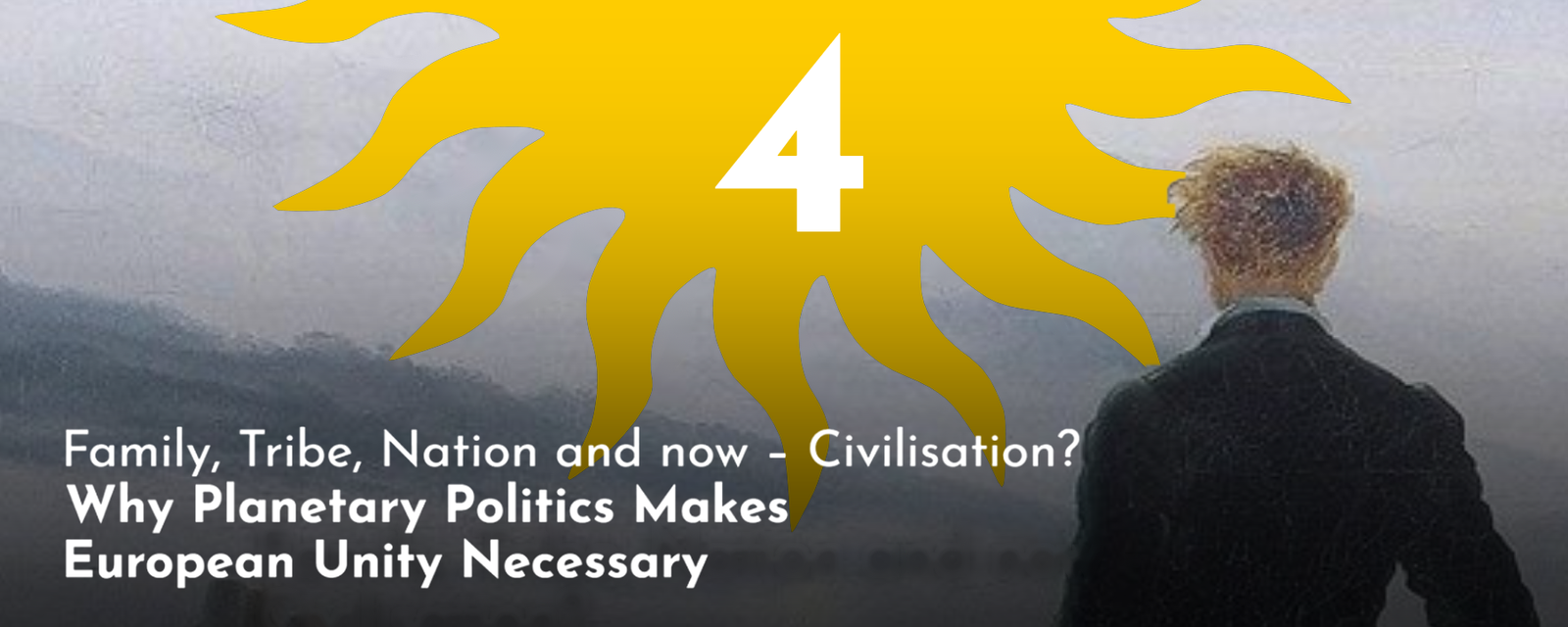
We will publish an article on Kjellén himself at a later point, but it ought to be stated here why this article has been translated and published. Rudolf Kjellén was a Swedish political scientist, historian, geographer, and right-wing member of parliament who lived from 1864 to 1922. He is a key figure in the development of political science as a discipline, and the man who coined the terms geopolitics and biopolitics. As the former term suggests, he is the father of the modern subdiscipline of geopolitics. In times such as our own, it is perhaps worthwhile to return to the origins of geopolitics in order to broaden our horizons and deepen our understanding of the discipline.
Furthermore, as pan-Europeans, it is worth noting that Rudolf Kjellén's study of the European and extra-European great powers - titled Stormakterna (The Great Powers) and published in 1905 - is a quite prophetic work. In it, he predicts not only that intra-European conflict will lead to European decline, but also that America will rise in the West and maintain a hegemonic grip over a disunited Europe through primarily economic means. He further predicts that this planetary shift in the balance of power will eventually give rise to what we would today call a "multipolar world." This, however, will be covered in greater depth at a later date.
Politics as Science
Every glance at history shows how states advance - in firmer or looser forms, in growth or in decline - yet always as some kind of unified beings. This quality of personality in political communities appears with particular force when we consider the great "powers" of our own time: how they "sit at the council table" and speak with one another, or go into the field and fight one another, each with its own will, its own calculations, its own character. The conception of states as personalities has also penetrated the popular imagination. One speaks of England, the United States, and so on as acting wills; and the caricaturist's imagination has gone further still, giving them proper names and outward form - the stout "John Bull," the tall and gaunt "Uncle Sam." All genuine knowledge of states must therefore presuppose, from the outset, a kind of personality in them. At any given moment they constitute a society of individuals, and towards them the politician directs his enquiring gaze - just as the psychologist does towards private individuals, or the zoologist towards animals. From empirical study of individual cases, he works his way towards general species (forms of state), and finally towards the state's own historically given essence and the laws by which it arises and develops.
In this study, the experiences drawn from the private human individual offer a useful point of departure, since that individual lies closer to our observation. The private person must be conceived from three points of view: the body, or external structure; the soul, or natural character; and the spirit, or rational being - principles and self-consciousness. In fairly close analogy, the modern state appears as a trinity: society, its body, the external multiplicity of particular and spontaneous interests and needs; nation, its soul, the character of the people; and the state in the specific sense - the spirit of the people, the rational organisation.
It has not always been so. Even now there exist state formations that have not acquired the foundation of a definite national personality. Austria is one example, and at the same time a demonstration of the force of the "principle of nationality," which in our age reacts against such anachronisms. It therefore becomes an important task for modern politics to show how states have increasingly matured into full personalities - with all the principal determinations of personality - from the earliest seeds in the social formations of primitive peoples.
From this point of view, politics in the widest sense encompasses the whole of history, insofar as history is understood as the science of the laws governing the development of state life. History is, at bottom, a political science. Yet after the practical differentiation of modern times, history and politics come to stand in roughly the same relation as geology and geography. They cannot dispense with one another: history cannot avoid studying the present results of its laws of development, nor can politics overlook the genesis of existing conditions. They differ in principle, however, in that the politician draws on the past only insofar as it serves him in understanding the present, whereas the historian views contemporary conditions only as a means of understanding development - the movement itself.
If it is the politician's specific task to seek systematic clarity in the study of the state communities of his own time - bearing, as every modern scholar must, the responsibility of assessing his object genetically - then this task breaks down into three specialised inquiries. Under general politics there fall, first, ethnography, which studies nations as the natural personalities of states; then sociology, which studies societies as the external, concrete formations of states; and finally constitutional law, which deals with the legal organisation of different states, their constitutions and systems of administration. This division presents itself most naturally as flowing from the very essence of states. The only question is whether constitutional law, as a science, fully covers the spiritual and conscious side of state life; for the time being, for the sake of simplicity, we may assume that it does.
The scientific student of state life therefore no longer contents himself with reading constitutions alone. He acquaints himself with the various societies which, in greater or lesser degrees of harmony, form the outward aspect of their respective states in the practical world. He studies the different peoples as individual entities who have fashioned these forms of state on the basis of their social positions. One need only reflect briefly on the fields of activity of these disciplines to appreciate the scope of political science - even after its separation from history has been carried through.
A limitation nevertheless already lies in the fact that the politician's interest embraces only those peoples who have developed into real states, and only those aspects of social life which directly characterise the state in question as an individual. Ethnography opens vast territories to its specialist researchers; sociology commands broad expanses of economic and other questions that scarcely concern the politician. Yet a certain measure of folk psychology and statistics must always remain within the domain of politics - this is indispensable for politics' primary task: to seek knowledge of the states that actually appear and are concretely present. Mere study of constitutions takes one little distance in this respect; it is no more sufficient for providing real knowledge of the practically acting state than the study of a person's principles is for arriving at secure knowledge of the person himself.
The result of our investigation into the domain of politics is therefore this: knowledge of the various state communities in their external and internal organisation, set against the background of their actually existing social structures and their individual national characters. Is the task thereby exhausted? For a long time it was believed to be so. But here the same mistake was made as when one sought knowledge of human beings solely by studying the human being himself. As an acting personality, the human being is subject to conditions outside himself - the influences of disposition, of environment, of circumstances. Without studying these as well, one never arrives at truly profound knowledge.
One of the deepest discoveries of our time is that knowledge of an object necessarily includes knowledge of its milieu. It is well known how fruitful this discovery has been for the history of art through Taine's method: to understand an artist, one must turn one's gaze to his lineage, his teachers, his friends, and his conditions of life in every kind. One can press this method too far, and ultimately come to conceive a spiritual being as nothing but a product of circumstances. Yet no scientific mind today can deny the legitimacy of the method itself, or fail to see the vistas of deepened knowledge it opens when applied with judgement.
In recent years this method has also entered the science of politics, and Friedrich Ratzel is its reformer here. That he calls his works "anthropogeography" and "political geography" is of no consequence; it is knowledge of the state that he deepens by investigating the various relations between the state and its "soil," its land. In its land and territorial form, the state individual possesses a framework given once and for all. Within it, all its possibilities of development lie dormant to a certain degree; beyond it the state cannot go. The framework may be expanded through conquest, broken apart by external pressure, and so forth; but at every particular moment it constitutes the state's necessary law, which limits its free will in history.
Knowledge of states must therefore, following Ratzel's initiative, be extended to include knowledge of their respective boundary conditions, general morphological preconditions, position, space, and form - in a word, their milieu. For a long time these factors were included in statistics as a loose appendage to constitutional arrangements. Only now have eyes been opened to the deep organic connection that must make this natural dimension of the state one of the central chapters of the political science of the future. All the sciences of our time strive to materialise themselves, to strike deeper roots in actual reality; and politics has not remained untouched by this tendency. In its case it manifests in an endeavour to clarify the roots that human state formation has in Mother Earth herself - alongside an endeavour to demonstrate the economic foundations of states within the societies themselves.
Let us first summarise the results of our preceding reflections on politics as a science. Politics seeks systematic knowledge of the empirically given states, or organised peoples. To this end it scrutinises these national personalities from the same points of view as those that present themselves in the study of the private individual: not only that of rational principles - most immediately expressed in the legal organisation, the subject of constitutional law - but also that of external social conditions and needs (political statistics or sociopolitics), of natural traits of character and qualities of mind (folk psychology or ethnopolitics), of prior development (parts of history), and of the surrounding geographical milieu (geopolitics).
Politics thus has as its nearest neighbours in the sciences: jurisprudence, which investigates the nature and forms of law; sociology, which studies the peculiar phases of social life even outside legal organisations; ethnography, which strives for a natural classification of the varieties of the human race without regard to their work of state formation; history, which traces the laws of the development of collective life itself; and geography, which confines itself to the surface of the earth as such, whether or not human beings have erected cultural structures upon it. Politics, as one sees, has many distinguished neighbours, some with illustrious pedigrees; and it is entirely natural that it should have found it somewhat difficult to secure an independent position within their circle - indeed, it may even have been regarded outright as a parasite, living on the crumbs from a rich table.
All such difficulties and suspicions, however, are immediately dispelled as soon as one fixes one's gaze upon the object of politics itself. If the state is an independent fact in human history, then its science too must be an independent discipline; and if it is not yet so, it will become so. One need only attend to states as empirical facts, and one will find politics just as naturally entitled to its place in the community of sciences as, for example, zoology. From this way of looking at the matter, a further two points of view may here be added to those already indicated.
The state as an empirical fact is not merely a legal organisation - a constitution and a system of administration - not even when that organisation is viewed against the background of its enduring society, its nationality, and its territory. Above all it is not something finished, not something static. It does not belong to inorganic nature. It is a life that moves, acts, operates inwardly and outwardly. It works continually to develop its organisation. It exercises daily activity within the framework of that organisation. It strives unceasingly to realise the possibilities of development offered by national disposition and geographical environment, and to overcome the limitations that flow from those same factors. In this way it comes into constant contact with other state entities - in trade and intercourse, for good and for ill. Like the private individual, it is placed in a struggle for existence, which absorbs a large part of its energies and produces a continual, greater or lesser, friction with its surroundings.
The theorising Germans - Bluntschli, for example - speak of politics in a special sense, as distinct from constitutional law. Constitutional law, they say, deals with the state as it is, tests the legality of institutions, and looks primarily at the constitution; politics deals with the state in its activity, tests the expediency of forms, and looks primarily at the mode of government. In this latter definition, part of what we have now sought to emphasise is already indicated. From it there follow, as corollaries, new fields for the activity of the modern political scientist.
Here we shall content ourselves with indicating two of them: parliamentary (or more generally, domestic) politics, which encompasses the current efforts towards improved organisation within states; and international politics, which elucidates the mutual relations and dealings of contemporary states and indicates the points of sharpest friction between them. Thus, through reflection on the state's own essence, one arrives at the discovery of one great field after another for an independent political science - one that need not cling to the skirts of history, jurisprudence, or any other science.
Lucas
FounderAve Europa Finland